
Overview
Geometric probability is a technique that involves using length, area, or volume to calculate probability. We can use this technique not only for problems explicitly involving geometry, but also for probability questions with continuous variables.
In a probability question, we want to find the ratio of the set of desired outcomes to the set of total outcomes. In a probability question with discrete variables, both sets have a finite size. However in a probability question with continuous variables, both sets have infinite size, but we need some way to compare their sizes without directly counting. This is where geometric probability can be useful. We can often convert these questions involving probability into questions involving geometry. Then, the sizes of the sets become length, areas, and volumes, which can be easier to deal with.
Key Ideas
(To avoid repeating myself, I will simply say area instead of "length/area/volume".)
- In a geometric probability problem, the probability is the ratio of the area of the desired outcomes to the area of the total outcomes
- These problems essentially have two parts: (1) modelling the problem geometrically (2) calculating the areas
- As in finite probability, it can be easier to find the probability of the complement (i.e. the probability of the event NOT happening)
Worked Example #1 (2011 AMC 10B #16)
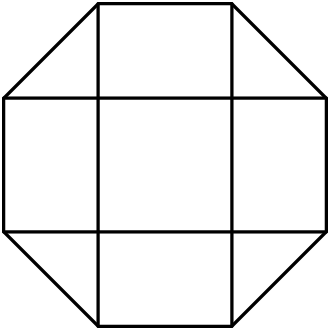
A dart board is a regular octagon divided into regions as shown. Suppose that a dart thrown at the board is equally likely to land anywhere on the board. What is the probability that the dart lands within the center square?
Solution
The probability that the dart lands within the center square is simply the ratio of the area of the center square to the area of the dart board. Since we are only concerned with the ratio between the areas, we can set the side length of the octagon to be to make the calculations easier.
Remember, don't be afraid to set lengths in geometry problems to a value that will make calculations easier.
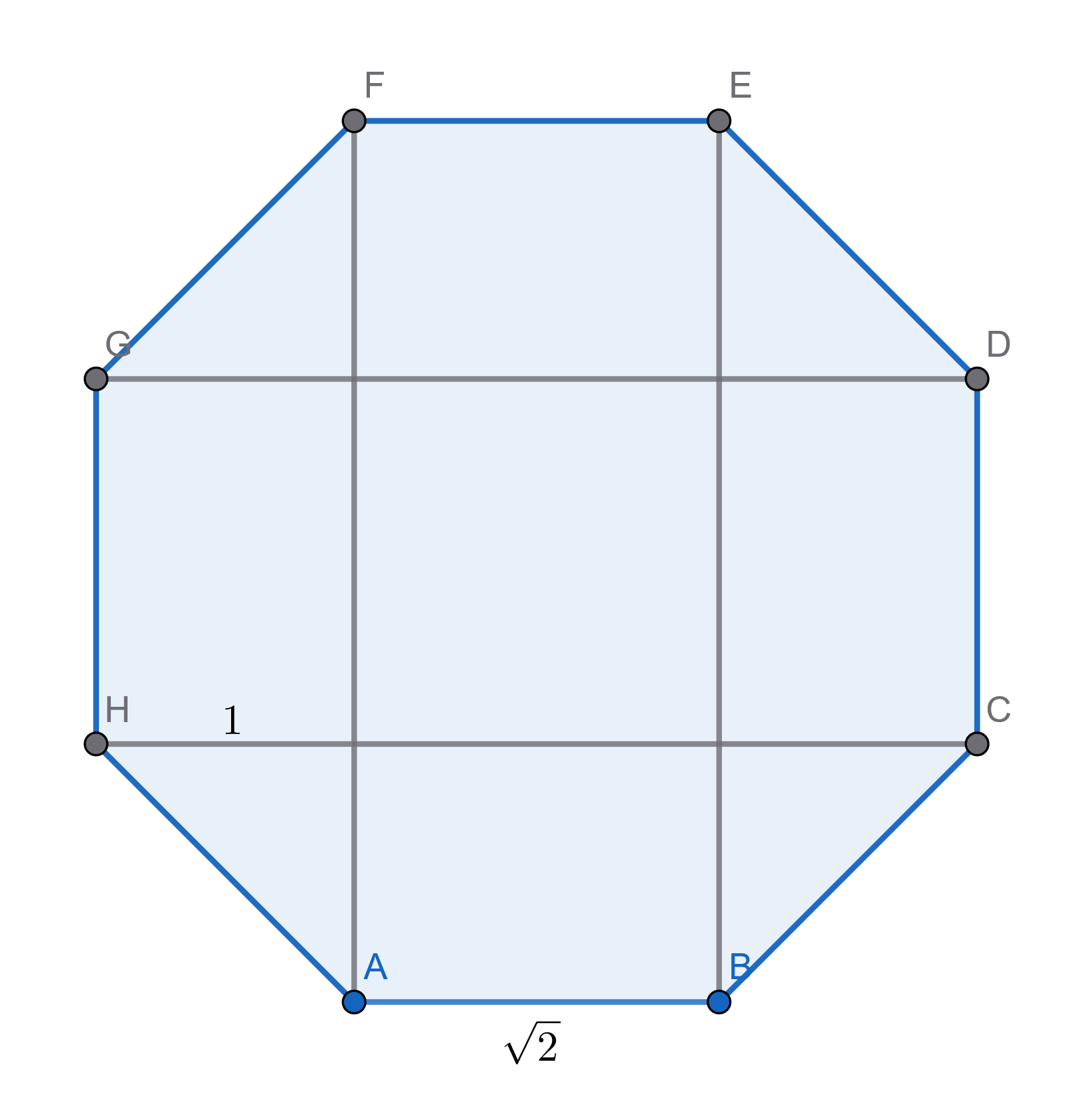
The side length of the octagon and the side length of the center square are equal. So, the area of the center square is simply .
By Pythagoras, the side length of one of the right triangles on the corners of the octagon is . So, the total area of the octagon is .
Our answer is simply the ratio of these two numbers.
Worked Example #2 (1998 AIME #9)
Two mathematicians take a morning coffee break each day. They arrive at the cafeteria independently, at random times between 9 a.m. and 10 a.m., and stay for exactly minutes. The probability that either one arrives while the other is in the cafeteria is and where and are positive integers, and is not divisible by the square of any prime. Find
Solution
The problem statement doesn't directly mention geometry, so we have to make a model of the problem that involves geometry.
Let , be the times the two mathematicians arrive in terms of minutes past 9 am. The mathematicians meet when . Consider plotting on a coordinate plane. Since the mathematicians arrive between 9 and 10 am, . This means all pairs of arrival times are in a square. The shaded region contains all pairs of arrival times where the mathematicians meet.
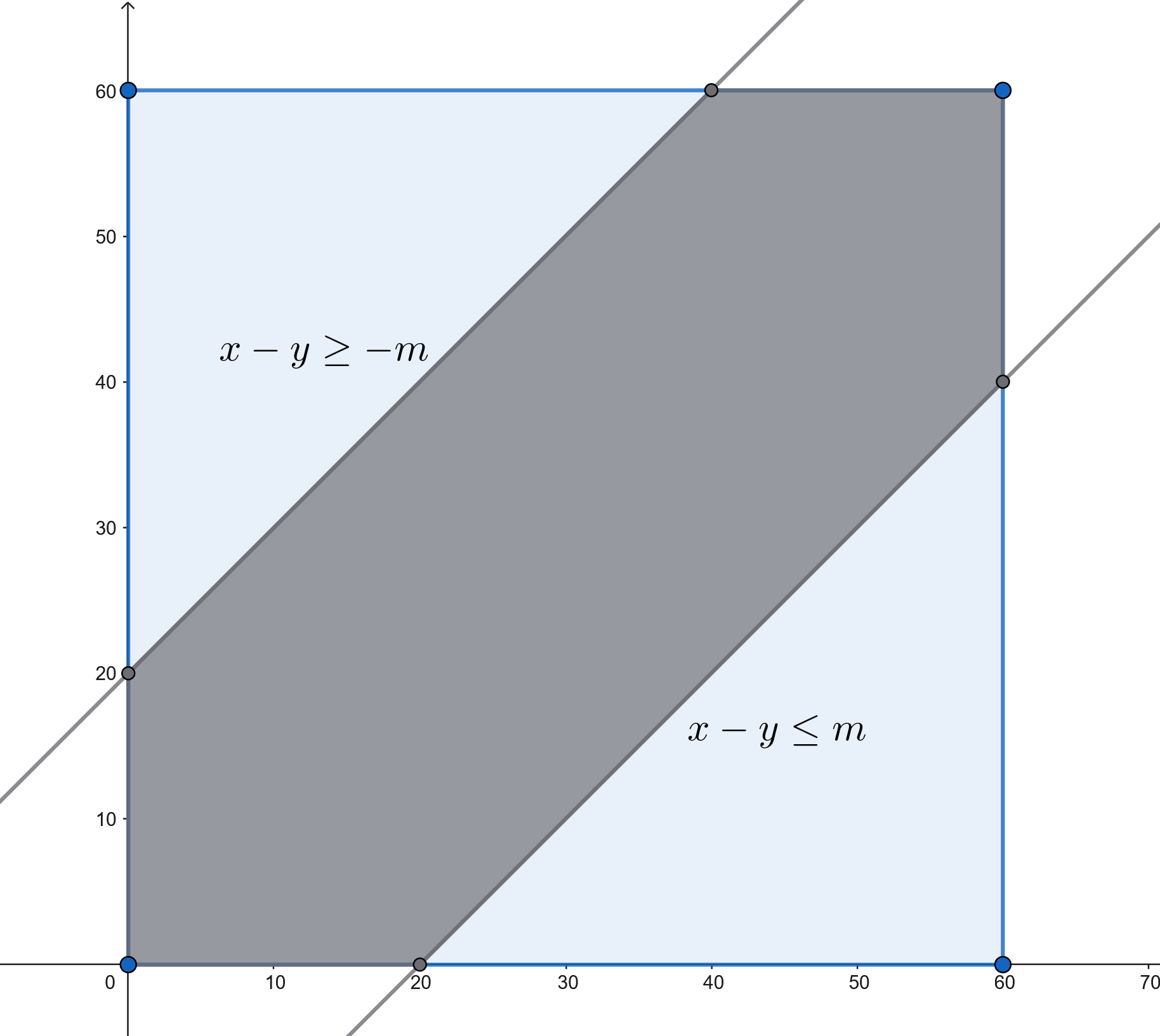
Thus, the probability of the mathematicians meeting is equal to the ratio of the shaded area to the total area (i.e. the square). Here, it's actually more convenient to calculate the ratio of the unshaded area (two right triangles) to the total area, which is the probability that the mathematicians do not meet (which is 0.6).
So the answer is .
Worked Example #3 (Throwing Darts!)
A normal circular dartboard has a radius of . A smaller, concentric circular that we will calls the bullseye is located at the center. A dart is thrown RANDOMLY and lands uniformly somewhere inside the large circle. If you are given that the probability that the dart lands OUTSIDE the bullseye but INSIDE the large circle is 84% your job is to find the radius of the bullseye.
Solution
To start off, the probability that the dart lands in the outer ring is simply the ratio of the area of the ring to the total area of the dartboard.
Next, remember that when working with complement regions (that's what these are called), it is usually a lot easier and more efficient to calculate the area of what you don't want instead of what you DO want.
Using this strategy, we get that the total area of the dartboard is simply . Furthermore, because the probability of the dart landing in the outer ring is that means that the probability of landing inside the bullseye is just
If we let be the radius of the inner bullseye, then we can make an equation using the ratio of the bullseye area to the total area and the rest of the calculations are as follows:
Worked Example #4 (Illegal Corner Cutting)
A point is chosen uniformly AND also randomly inside of a square whose side lengths are of length . Your job is to find the probability that the distance from to the closest vertex of the square is GREATER than .
Solution
First off, notice that the problem is asking for a probability based on a distance constraint from the corners of a square, and we can easily visualize this as circular regions!
So now, realize that the total area of the square is merely . Next, the region where the distance to a vertex is LESS than or equal to makes a quarter-circle that has a radius of at EACH of the corners.
Combining all this, we get that these quarter-circles form a complete circle of radius . Now, the total area of this INVALID region is simply as follows:
Next, subtracting this from the total area gives the VALID region in the center of the square:
Thus, our answer is just the ratio of the valid area to the total area, and we get our answer below!
Worked Example #5 (Points on a segment! (how boring))
A point is chosen uniformly and randomly on a line segment that has length of . Your job is to find the probability that the area of a square with side length of is less than or equal to .
Solution
To start off, notice that we can model the position of point CONTINUOUSLY along the line segment.
Now, we will let the length of the segment be . Then, because HAS TO land on the segment , can basically be anywhere from to , which consequently makes the total available length .
From here, recall that the area of a square with side length is simply the formula . Now, we write the inequality from the problem statement:
Essentially, this implies that must be chosen WITHIN the first units of the segment starting from the endpoint which is . Lastly, the probability is the ratio of this valid length to the total length.
Worked Example #6 (The Tilted Cutting Line)
A point is chosen uniformly and randomly inside the following rectangle: rectangle . Your job is to find the probability that the coordinates of satisfy the inequality .
Solution
We can find the probability by plotting the region defined by the inequality inside the boundaries of the rectangle in the coordinate plane.
The total area of the rectangle is .
To find the valid region, we determine where the boundary line intersects the edges of our rectangle:
The line connects to , slicing the rectangle exactly in half along its diagonal. The inequality represents the lower-left right triangle formed beneath this diagonal.
Since the line bisects the rectangle perfectly, the area of this triangle is exactly half of the total area.
Worked Example #7 (Closer to the Center)
A point is chosen uniformly at random inside a square of side length . Your job is to find the probability that is closer to the center of the square than it is to any of the four corners of the square.
Solution
To solve this problem, we need to find the geometric boundary where a point is perfectly equidistant from the center of the square and its vertices.
The total area of the square is . The boundary lines where points are equally distant between the center and the corners are formed by the perpendicular bisectors of the segments connecting the center to each vertex.
Remember, the perpendicular bisector of a segment represents the exact locus of points equidistant from both endpoints.
These boundary lines connect the midpoints of the four outer sides of the square, creating a smaller, tilted square diamond inside the main square. Connecting the midpoints of any square always partitions the space such that the inner diamond encloses exactly half of the total area.
Worked Example #8 (The Two-Stick Choice)
Two independent numbers and are chosen uniformly at random from the interval . Your job is to find the probability that .
Solution
We can model the independent choices of and as a two-dimensional region on a standard coordinate plane.
Since both variables are chosen from the interval , the total sample space is represented by a square with a total area of .
We rewrite the inequality to graph it easily:
The boundary line crosses the bottom edge of the square at and the right edge of the square at . The inequality describes the region below this line, which forms a small right triangle in the bottom-right corner of the sample square.
The base of this triangle along the -axis is , and its height along the right edge is . We calculate the area of this triangle:
The probability is the ratio of this triangular area to the total square area.
Practice Problems
| Status | Source | Problem Name | Difficulty | Tags | ||
|---|---|---|---|---|---|---|
| Berkeley Math Circle: Monthly Contest 6 | Hard | Show TagsCombinations, Other | ||||
| MathNet | Hard | Show TagsOther, Permutations | ||||
| MathNet | Hard | Show TagsOther | ||||
| MathNet | Hard | Show TagsMath Word Problems, Other | ||||
| Berkeley Math Circle Monthly Contest 1 | Hard | Show TagsOther | ||||
| Berkeley Math Circle | Hard | Show TagsOther | ||||
| Berkeley Math Circle: Monthly Contest 6 | Hard | Show TagsCombinations, Other | ||||
| Harvard-MIT Math Tournament | Hard | Show TagsMath Word Problems, Other | ||||
| Harvard-MIT Math Tournament | Hard | Show TagsOther, Single-variable | ||||
| Harvard-MIT Math Tournament | Hard | Show TagsOther | ||||
| Harvard-MIT Math Tournament | Hard | Show TagsCombinations, Other | ||||
| Harvard-MIT Math Tournament | Hard | Show TagsMath Word Problems, Other | ||||
| Harvard-MIT Math Tournament | Hard | Show TagsOther | ||||
| Harvard-MIT Math Tournament | Hard | Show TagsOther | ||||
| Harvard-MIT Mathematics Tournament | Hard | Show TagsOther | ||||
| Harvard-MIT Mathematics Tournament | Hard | Show TagsOther | ||||
| Harvard-MIT Mathematics Tournament | Hard | Show TagsOther, Permutations | ||||
| Harvard-MIT Mathematics Tournament | Hard | Show TagsOther | ||||
| Harvard-MIT Mathematics Tournament | Hard | Show TagsOther | ||||
| Harvard-MIT Mathematics Tournament | Hard | Show TagsOther | ||||
| Harvard-MIT Mathematics Tournament | Hard | Show TagsOther | ||||
| Harvard-MIT Mathematics Tournament | Hard | Show TagsOther | ||||
| Harvard-MIT Mathematics Tournament | Hard | Show TagsOther | ||||
| Harvard-MIT Mathematics Tournament | Hard | Show TagsOther | ||||
| Harvard-MIT Mathematics Tournament | Hard | Show TagsOther | ||||
Module Progress:
Join the Discord Community!
Stuck on a problem, or don't understand a module? Join the Discord and get help with your doubts while making more math friends.