
Introduction
If right-triangle trigonometry is the vocabulary of trig, the unit circle is the grammar that lets everything else make sense. Recall that with right triangles, sine and cosine are only defined for acute angles: angles strictly between and . The unit circle breaks this restriction entirely. It extends sine, cosine, and tangent to every real-number angle, positive or negative, large or small.
The unit circle is the circle of radius centered at the origin of the coordinate plane. Its equation is simply:
Every point on this circle will turn out to encode a complete trigonometric story.
Radians: A Better Unit
Before diving into the circle itself, we need to talk about how we measure angles. You are likely familiar with degrees, but most serious mathematics uses radians.
One radian is the angle subtended at the center of a circle by an arc whose length equals the radius. Since the circumference of the unit circle is , a full revolution corresponds to exactly radians. Hence:
To convert between the two systems, let be an angle in degrees and its radian measure:
Some conversions worth memorizing:
| Degrees | Radians |
|---|---|
Radians are preferred not merely by convention, it's because they make calculus, series expansions, and virtually every formula in higher mathematics easier. When an angle appears raw in a formula (like or ), it is always in radians.
Connecting the Circle to Right Triangles
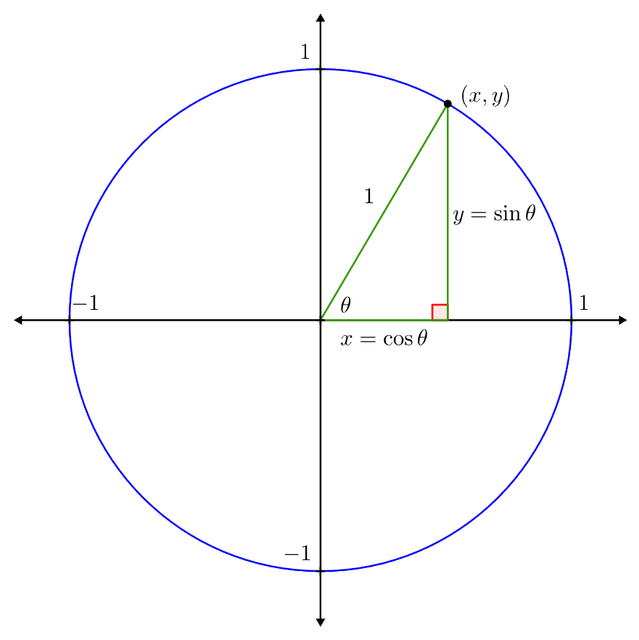
Pick any point on the unit circle and draw the segment from the origin to . Drop a perpendicular from to the -axis, landing at . This produces a right triangle with:
- Hypotenuse (radius of the unit circle)
- Horizontal leg
- Vertical leg
 Credit: Brilliant
Let be the angle at , measured counterclockwise from the positive -axis. Applying the standard SOH-CAH-TOA definitions:
This yields the central fact:
The power of this definition is that it works for any angle. When moves into the second quadrant, becomes negative, so .
The Pythagorean Identity
Since every point on the unit circle satisfies , substituting and gives immediately:
This is the Pythagorean Identity, the single most useful trig identity. Dividing through by or yields two more:
Signed Angles and the Four Quadrants
An angle on the unit circle is always measured from the positive -axis with the vertex at the origin. It is positive when swept counterclockwise and negative when swept clockwise. The terminal side is the ray from the origin through the point on the unit circle.
 Credit: Brilliant
The signs of and depend on which quadrant the terminal side falls in:
| Quadrant | ||||
|---|---|---|---|---|
| I () | ||||
| II () | ||||
| III () | ||||
| IV () |
A useful mnemonic: All Students Take Calculus... going counterclockwise from Quadrant I, the functions that are positive are All, Sine, Tangent, Cosine.
Special Angles
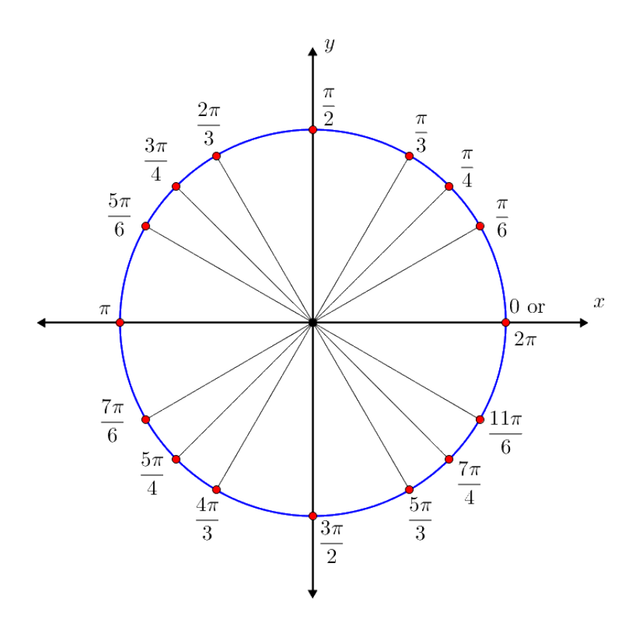
The special angles are those for which the coordinates can be computed exactly from -- and -- triangle relationships. Memorizing these is essential for every competition and course involving trigonometry.
 Credit: Brilliant
| (radians) | (degrees) | |||
|---|---|---|---|---|
| undefined | ||||
| undefined |
Rather than memorizing this table as a list of facts, notice the pattern in the sine column for the first quadrant:
The numerators run in order. The cosine column runs the same sequence in reverse.
Coordinates in the Unit Circle
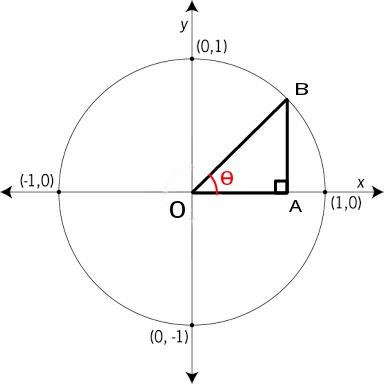
A right triangle with right angle at lies on the Cartesian plane such that lies on the -axis, point lies at the origin, and point lies anywhere on the unit circle. Note that unit.
 Credit: Brilliant
When defining sine and cosine in terms of the unit circle, lengths can be negative. If extends along the negative -axis, then is negative; if extends below the -axis, is negative. Under this convention:
The sine of an angle is the -coordinate of its point on the unit circle; the cosine is the -coordinate.
Worked Examples
Example 1. A line through the origin meets the unit circle at angle . Find the coordinates of that point.
Since the coordinates are :
So the point is .
Example 2. A point on the unit circle has -coordinate . Find .
Since , we have . By the Pythagorean identity:
Therefore:
Allied Angles (Reduction Formulas)
One of the most practical payoffs of the unit circle is a complete set of reduction formulas that let you express any trig function of a "compound" angle like or purely in terms of , , and . Competitions use these constantly; so does every calculus course.
How to derive them?
The key insight is that the unit circle encodes geometry, not algebra. For any angle , the point sits on the circle. When you add or subtract a multiple of , the point rotates to a new quadrant. Reading off the new coordinates tells you exactly which function appears and what sign it carries.
The two-step recipe:
Function type : if the shift is an odd multiple of (i.e. , ), the function swaps: , , . If the shift is an even multiple of (i.e. , , ), the function stays the same.
Sign : imagine is a small positive acute angle and ask: in which quadrant does the compound angle land? Use ASTC to determine the sign of that function there.
That's it. You can derive any entry in the tables below on the fly.
Worked derivation: :
Place in Quadrant I, so the point is . Rotating counterclockwise maps , so the new point is . The -coordinate of this new point is , and lands in Quadrant II where sine is positive. Hence:
Every formula below follows from the same rotation argument.
Shifts by
| Function | ||
|---|---|---|
Function swaps (sin↔cos, tan↔cot, sec↔csc). Sign from ASTC: stays in Q I (all positive); lands in Q II (only sine and cosecant positive).
Shifts by
| Function | ||
|---|---|---|
Function stays the same. is in Q II (sin and csc positive, rest negative); is in Q III (tan and cot positive, rest negative).
Shifts by
| Function | ||
|---|---|---|
Function swaps again (odd multiple of ). is in Q III (tan and cot positive); is in Q IV (cos and sec positive).
Shifts by (and negative angles)
| Function | |||
|---|---|---|---|
Function stays the same (even multiple of ). is just periodicity, a full revolution returns to the same point. and both reflect across the -axis: the -coordinate negates while stays fixed, which is exactly why sine is an odd function () and cosine is an even function ().
Quick-fire examples
Simplify .
shift → function stays the same (). lands in Q III where tangent is positive. So .
Simplify .
shift → function swaps (). lands in Q III where cosine is negative. So .
Simplify .
shift → function swaps (). lands in Q II where cosecant is positive. So .
Contest Problems
Unit Circle Sign Problem
If , which of the following is true?
 Credit: Brilliant
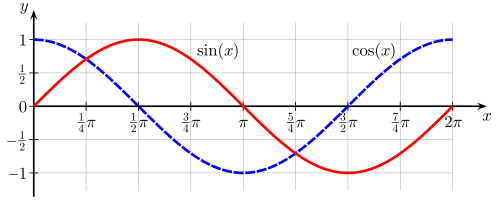
The angle lies in Quadrant II, so and . To determine the sign of their sum, note that . Using the cofunction shift:
So . Since , we have (sine exceeds cosine for angles past in the first quadrant), hence:
The Unit Circle Toolkit
Much like GCD and LCM problems reduce to isolating one prime at a time, unit circle problems reduce to identifying the quadrant and reference angle. Here is a summary of the key tools:
| Situation | Tool |
|---|---|
| Evaluating or for a special angle | Unit circle table |
| Angle outside | Reduce modulo (or ) |
| Angle in Quadrant II/III/IV | Reference angle + ASTC sign rule |
| Equation involving | Pythagorean identity |
| Expression mixing and | Convert to /, simplify |
| Degree–radian conversion |
Reference Angles
For any angle , the reference angle is the acute angle between the terminal side and the -axis. The absolute values and equal and ; the signs are determined by ASTC.
| Quadrant | Reference angle |
|---|---|
| I | |
| II | |
| III | |
| IV |
Remarks
The unit circle is the gateway to everything deeper in trigonometry: the graphs of sine and cosine as periodic functions, the complex exponential (Euler's formula), Fourier series, and the geometry of rotations in any dimension. Whenever you encounter a trigonometric expression, ask yourself: where on the unit circle does this live, and what does the geometry tell me? That habit will make most competition trig problems feel almost effortless.
Practice Problems
| Status | Source | Problem Name | Difficulty | Tags | ||
|---|---|---|---|---|---|---|
| Berkeley Math Circle: Monthly Contest 8 | Hard | Show TagsTrigonometric functions | ||||
| MathNet | Hard | Show TagsFunctions, Trigonometric functions | ||||
| Harvard-MIT Mathematics Tournament | Hard | Show TagsTrigonometric functions | ||||
| Harvard-MIT Mathematics Tournament | Hard | Show TagsTrigonometric functions | ||||
| Harvard-MIT Mathematics Tournament | Hard | Show TagsTrigonometric functions | ||||
| Harvard-MIT Math Tournament | Hard | Show TagsSingle-variable, Trigonometric functions | ||||
| Harvard-MIT Math Tournament | Hard | Show TagsTrigonometric functions | ||||
| Harvard-MIT Math Tournament | Hard | Show TagsApplications, Single-variable, Trigonometric functions | ||||
| Harvard-MIT Math Tournament | Hard | Show TagsApplications, Derivatives, Trigonometric functions | ||||
| Harvard-MIT Math Tournament | Hard | Show TagsTrigonometric functions | ||||
| Harvard-MIT Mathematics Tournament | Hard | Show TagsTrigonometric functions | ||||
| Harvard-MIT Mathematics Tournament | Hard | Show TagsLimits, Trigonometric functions | ||||
| Harvard-MIT Mathematics Tournament | Hard | Show TagsODEs, Trigonometric functions | ||||
| Harvard-MIT Mathematics Tournament | Hard | Show TagsApplications, Single-variable, Trigonometric functions | ||||
| Harvard-MIT Mathematics Tournament | Hard | Show TagsLimits, Trigonometric functions | ||||
| Harvard-MIT Mathematics Tournament | Hard | Show TagsTrigonometric functions | ||||
| Harvard-MIT Mathematics Tournament | Hard | Show TagsSingle-variable, Trigonometric functions | ||||
| Harvard-MIT Mathematics Tournament | Hard | Show TagsLimits, Trigonometric functions | ||||
| Harvard-MIT Mathematics Tournament | Hard | Show TagsLimits, ODEs, Trigonometric functions | ||||
| Harvard-MIT Mathematics Tournament | Hard | Show TagsDerivatives, Trigonometric functions | ||||
| Harvard-MIT November Tournament | Hard | Show TagsFunctions, Trigonometric functions | ||||
| Harvard-MIT Mathematics Tournament | Hard | Show TagsDerivatives, Limits, Trigonometric functions | ||||
| HMMT November 2012 | Hard | Show TagsTrigonometric functions | ||||
| HMMT February | Hard | Show TagsFunctions, Trigonometric functions | ||||
| HMMT February 2016 | Hard | Show TagsSingle-variable, Trigonometric functions | ||||
Module Progress:
Join the Discord Community!
Stuck on a problem, or don't understand a module? Join the Discord and get help with your doubts while making more math friends.